Jump Logs: Local Co-op (#5) | August 2026
Hello! This is the fifth Jump Log so far, and sorry this one is a little late! Although, the good thing about these blog posts is that they aren't exactly popular and are really just a way of holding myself accountable for actually documenting the game. That means I can change the date of this blog post and no one will be any the wiser!
For this month's Jump Log, I wanted to talk about the local co-op side of Dimension Jumper. In particular, why I wanted to include it in the first place, why I decided to focus on local multiplayer rather than network multiplayer, and finally, what I hope to achieve with it further down the line.
Why Co-op?
![Figure 1 - Dimension Jumper (Pre-Alpha v0.1), Testing Local Co-op [Video Game]](https://static.wixstatic.com/media/2c1d35_3b92d5bef01e482693f4efbf08503f97~mv2.png/v1/fill/w_980,h_551,al_c,q_90,usm_0.66_1.00_0.01,enc_avif,quality_auto/2c1d35_3b92d5bef01e482693f4efbf08503f97~mv2.png)
I've briefly talked about this before, but there are two main reasons why I wanted co-op in Dimension Jumper. Firstly, I think the design lends itself really well to having multiple players. Sorcery, which Dimension Jumper takes a great deal of inspiration from, never incorporated multiplayer, so I felt like this was a nice way of taking that core idea and giving it something a little different.
The second reason is much more personal: I wanted a game that I could sit down and play with my brother. He's actually one of the reasons Dimension Jumper exists in the first place, so being able to eventually play it together feels like a nice full-circle moment.
We're also seeing a bit of a resurgence in indie co-op games at the moment, and I'd love for Dimension Jumper to eventually become a small part of that.
The Fundamentals
To get started with local co-op, I worked through James Doyle's Unity course, Learn To Create A Local Multiplayer Game In Unity, which is available on Udemy, and I genuinely couldn't recommend it enough. The course is aimed at beginners, but even as someone who has been using Unity for over five years, I still found myself learning new things about the engine and, more importantly, how to properly incorporate local co-op into a project.
From there, I started putting my own spin on the system. One of the first ideas I wanted to explore was drop-in/drop-out co-op, where players could join or leave the game whenever they wanted.
As development progressed though, this started creating more problems than I expected. I had to consider things like dynamically balancing the game depending on how many players were present, what happens to items currently being held by a player when they leave, and how scoring should work if somebody drops out halfway through a level.
Eventually, I decided that a much simpler approach would be better for Dimension Jumper. Rather than having players join and leave during a level, I created a lobby where you choose the number of players before starting.
That has given me a much cleaner flow: Main Menu → Lobby → Level Select → Level.
It also means I know exactly how many players I'm working with before the level begins, which makes a lot of the systems further down the line much easier to manage.
The Lobby (v0.4)
I do have a few surprises planned for the multiplayer side of things that I don't want to talk about just yet, but what I can show is an early build of the lobby. There is still a lot that needs to be considered and refined, but this early version helped me establish how I wanted the multiplayer experience to feel.
![Figure 2 - Dimension Jumper (Pre-Alpha v0.5), The Lobby [Video Game]](https://static.wixstatic.com/media/2c1d35_2e7bc92830f64d58a0671b49e477197e~mv2.jpg/v1/fill/w_980,h_551,al_c,q_85,usm_0.66_1.00_0.01,enc_avif,quality_auto/2c1d35_2e7bc92830f64d58a0671b49e477197e~mv2.jpg)
The player characters are placed on individual podiums (see figure 2), making it immediately clear how many players can join you (up to four in total). When a player joins, a manager keeps track of how many players are currently in the lobby, and that information is then carried between scenes. Depending on that number, the appropriate amount of players will be spawned when entering the level.
UI & Player Readability
One design decision I've made here is how the UI is presented. You'll notice that some UI appears directly above the player characters, and I'm using this space for dynamic player-specific information. The UI that sits within the borders of the screen, on the other hand, isn't designed to be interacted with and won't contain player prompts. I like this approach because it keeps the important gameplay information within the playable space rather than constantly asking the player to look towards the borders of the screen.
Two Players, One Keyboard
Something else I wanted to support was the ability for two players to share the same keyboard.
Player 1 can use either a keyboard or controller, while Player 2 can also use the keyboard or a controller. Players 3 and 4 are then strictly controller-based. This was definitely a challenge to incorporate, but it was another one of those features that I really wanted to have available.
Not everyone has multiple controllers sitting around, and I wanted there to be an option for two people to simply sit down at the same PC and play Dimension Jumper together without needing to buy anything extra.
Does Four-Player Co-op Actually Work?
The more I've worked on it, the more I feel like four players actually fit the game's design surprisingly well.
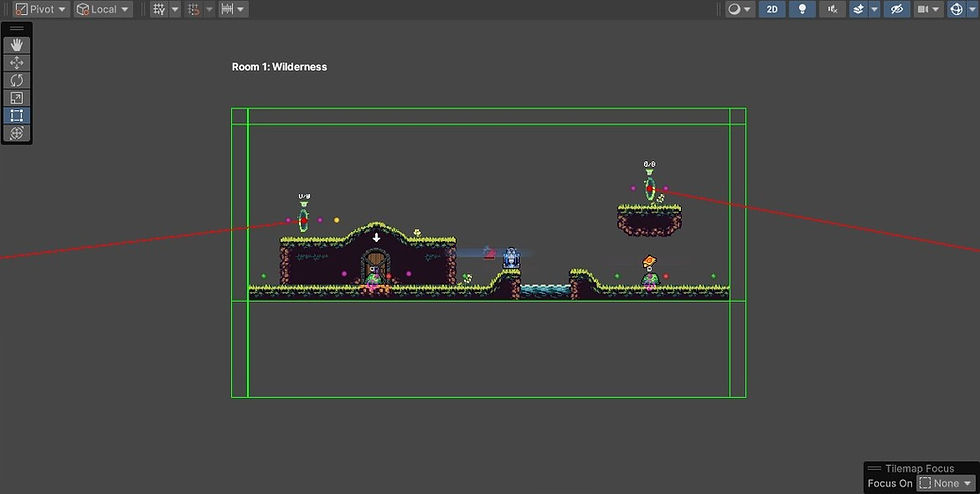
The important thing is that players still tackle each room as a group. Rather than having the camera constantly move between different rooms depending on where each player is, the camera stays with the group and moves as everyone progresses together. This keeps the room structure intact while still allowing four people to play at the same time.
One of my biggest considerations has been making sure the rooms don't feel too cramped. Four players, enemies, items and everything else happening on screen can very quickly make a room feel crowded, so balancing that has been challenging and is something I'm still working on as I refine the levels.
![Figure 3 - Dimension Jumper (Pre-Alpha v0.4), Local Co-op [Video Game]](https://static.wixstatic.com/media/2c1d35_e748b2e445e14373930aac51add42290~mv2.png/v1/fill/w_980,h_551,al_c,q_90,usm_0.66_1.00_0.01,enc_avif,quality_auto/2c1d35_e748b2e445e14373930aac51add42290~mv2.png)
Flow is another thing I've had to think about. One player might be quicker than another and want to move on to the next room, so I'm currently considering adding a small countdown when a player enters a portal. Rather than having somebody stand around waiting indefinitely for everyone else, it would give the group a little bit of time to catch up before progressing.
Why Local Co-op?
I decided to focus on local co-op because I really wanted to capture that retro feeling of sitting in the same room and playing a game with your friends.
I'm not completely writing off network multiplayer in the future. The groundwork I've built for local multiplayer could potentially be expanded, and I do have some experience working with networking. But at this stage, adding online multiplayer would have increased the scope of Dimension Jumper quite considerably, and I already have more than enough to work on!
If online multiplayer becomes a heavily requested feature in the future, then who knows? For now though, local co-op is where my focus is.
There's More To Come
I have a lot more ideas for where I want the local co-op side of Dimension Jumper to go. There's the question of what it means to fight alongside your friends (or even fight your friends...) and how the lobby itself can tie into the narrative, scoring, player personalisation, customisation and more.
But rather than throwing all of that information at you in one post, I thought it would be more interesting to show where the system started and how an earlier build first incorporated local co-op into the game.
I'm not completely sure what I'll share in the next Jump Log yet, but I'll have a think! Depending on how development progresses, I might even show off a newer build of the game.
I'm also aware that this post didn't go too deeply into the technical side of implementing local co-op and focused much more on the design decisions behind it. I think that's something I'd like to return to in a future Part 2, where I can properly dive into how I've handled the multiplayer systems behind the scenes.
But for now, thanks very much for reading, and I hope to see you again in the next Jump Log! Thanks!


Comments