
Consortium's Fall: Echoes of Xo'lara
Project Info
Role(s): Game Designer, QA Tester, Video Editor
Team Size: 6
Timeline: Sept 2024 - Mar 2025
Engine: Unreal Engine 5 (C++)
Tags: 3D, Action-Roguelite, Combat, Roguelike, Sci-Fi
Updated: Mar, 2026
I worked in a small team made up of developers from Thunder Blossom Games to help one of the members bring their passion project to Steam. The project was a twin-stick shooter being developed by a solo programmer who was looking for support with areas such as enemy design, weapons, level ideas, and improvements to the UI/UX. As a small team, we collaborated to help shape these elements and move the project closer to a public release.
Within five months, the team successfully launched the game’s Steam store page, with a playable demo released shortly afterwards. Development continued until March 2025, when the collaborative phase of the project wrapped up, and the original developer returned to focusing on the remaining programming work.
I was particularly excited to be involved in this project as it gave me another opportunity to work in Unreal Engine 5. The game’s visual style and fast-paced gameplay also make it a strong addition to my portfolio, and I’m looking forward to seeing how it develops toward its full release.


On this project, I contributed as a Game Designer, QA Tester, and Video Editor. Initially, in my role as Game Designer, I was tasked with designing a variety of enemies and weapon power-ups to add more variety and challenge to the gameplay. These included enemies such as Standard Assault Ships, Cluster Bombers, and Regen Spaceships, as well as power-ups like Loot Goblin, Chain Lightning, and the Dimension Shredder (a weapon that rips enemies from the ground as a tear in space-time opens beneath them, inspired by the "crack in the wall" from Doctor Who and the instant-kill effect of Mehrunes’ Razor from The Elder Scrolls series).
For enemy design, I studied games such as The Witcher 3: Wild Hunt (2015) and Warhammer 40,000: Space Marine 2 (2024), while weapon ideas drew inspiration from titles known for their distinctive arsenals, including Halo 3 (2007) and Ratchet & Clank (2002). My goal was to ensure these designs felt appropriate and suited the pace and structure of a twin-stick shooter. I would iterate on these concepts before presenting them to the team for discussion and feedback.
I later moved on to designing bosses for each of the game’s biomes, with each encounter featuring multiple unique phases. These bosses included the Iron Dominion, the Cosmic Sentinel, the Toxic Bomber, and the Shapeshifter’s Reckoning.
To round out my contributions, I regularly provided playtesting feedback as a QA Tester and supported the game’s marketing efforts as a Video Editor. This included capturing in-engine beauty shots and creating trailers to showcase the game’s visuals and features.
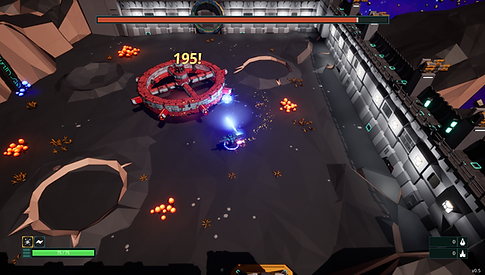

Working on this project helped me learn a lot about the different roles I was contributing to. One lesson that connected all three roles was the importance of communicating ideas clearly with the rest of the team and being open to feedback as work evolves. Whether I was presenting a new enemy concept, a weapon idea, or the latest version of a trailer, I gradually became more confident in explaining my thinking and responding to feedback as we refined things together.
If I were to start the project again, I would try to involve more players and fans of the twin-stick shooter genre earlier in development. Most of the feedback we received came from internal developers, which was still extremely valuable, but when it comes to balancing gameplay elements such as weapons and upgrades, broader player feedback would have been incredibly helpful.
Managing Layered Mechanics
One of the biggest challenges was balancing the many layered mechanics used across enemies and weapon power-ups. Enemies had multiple variables to consider, including maximum health, movement speed, projectile damage, and cooldown periods after attacking to prevent them from spamming attacks. Weapon power-ups added another layer of complexity, with modifiers such as damage, cooldown, rate of fire, discovery chance, status effects, blast radius, and force.
Since upgrades could be stacked through the in-game shop, certain combinations had the potential to become extremely powerful when players discovered the right synergy. While these moments could be fun, they also required careful testing and iteration to ensure the overall experience remained balanced and enjoyable throughout a full playthrough.